The explosive growth of WordPress from 2009 onward offers a clear blueprint for how the Odoo ecosystem will absorb and scale its needed labor capacity in Australia.
Just as WordPress surged past a 10% market share by pulling in thousands of freelance web designers, PHP devs, and small agency owners who were looking to escape low-margin work, Odoo S.A. and Australian partners face the exact same talent pipeline dynamic today.
Here is how the WordPress historical playbook predicts the expansion of Odoo’s skilled labor capacity, and how web implementers fit into that pipeline:
1. The Migration of the “Web Freelancer” Class
Around 2009–2012, building simple 5-page brochure sites on WordPress was lucrative. Today, dragging-and-dropping basic sites or setting up standard WooCommerce stores has hit a plateau. Freelancers and agency owners are feeling the margin squeeze.
- The Historical Parallel: In the early 2010s, Static HTML/Flash developers migrated en masse to WordPress because that was where the client budgets moved.
- The Odoo Shift: Experienced WordPress and WooCommerce implementers represent the most accessible pool of technical talent to retrain. They already understand:
- Client discovery and requirements gathering.
- Data structures (products, variants, SKUs, customer records).
- Basic web APIs, webhooks, and front-end/backend touchpoints.
- Managing non-technical business clients through software changes.
Retraining a WooCommerce implementer on Odoo’s core functional workflows (Sales > Inventory > Invoicing) is significantly faster than teaching an enterprise SAP consultant how to be an agile, low-cost regional implementer.
2. The Rise of “Hybrid Co-Delivery” (The Tiered Talent Model)
In the WordPress ecosystem, non-developer implementers built massive businesses by pairing themselves with high-end plugin/theme PHP developers. The implementers handled 80% of the client-facing work, while senior devs built the custom backend logic.
Odoo capacity will scale using the exact same division of labor:
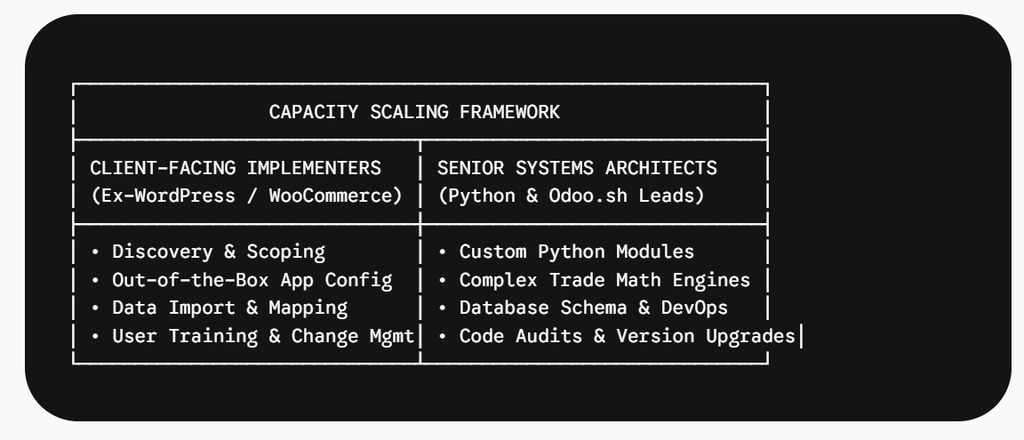
By removing the requirement that every consultant on an Odoo project must be a senior Python engineer, the market can absorb functional implementers to handle client onboarding, drastically multiplying total project bandwidth.
3. Upskilling via Paid Ecosystem Training
When WordPress exploded, platforms like WP101, Treehouse, and local Meetups commoditized WordPress education, turning graphic designers into functional web implementers almost overnight.
Odoo S.A. and regional consortiums (like Scoop) will expand capacity by offering structured, paid “Cross-Skilling Pathways” specifically designed for web professionals:
- Functional Certification Tracks: Teaching web implementers how Odoo’s double-entry inventory and general ledger behave compared to basic e-commerce checkouts.
- Low-Code/No-Code Bridging: Showing implementers how to configure 80% of a client’s needs using native Odoo UI tools, Odoo Studio, and pre-built vertical modules before calling in a Python developer for the remaining 20%.
4. Market-Driven Rate Elevation (The Economic Pull)
Talent flows where the financial incentives are highest.
In 2009, web developers realized they could charge $3,000 for a WordPress site instead of $500 for static HTML. Today, those same practitioners are discovering that an entry-level Odoo ERP implementation commands $15,000 to $50,000+ at billing rates of $150–$250/hr.
This economic pull will naturally draw the sharpest local web implementers out of the stagnated CMS market and into the Odoo ecosystem – providing the exact labour volume Odoo Australia needs to meet national demand.