Author: Neil Murray

  • How an Implementation Partner Uses Odoo Studio

    When deploying Odoo on Odoo.sh for a mid-sized metal fabricator, the implementation workflow relies on a clear division of technical labor. Core backend trade math—such as dynamic bar densities ($\rho = 7850\text{ kg/m}^3$), sheet girth slitting yields, and automatic Bill of Materials (BOM) generation—is securely coded in Python within a custom Git repository (e.g., odoo_fab_core).

    However, the Odoo Implementation Partner (OIP)—the client-facing consultant who conducts discovery and manages the front-end setup—uses Odoo Studio directly in the browser to bridge the gap between underlying Python logic and daily factory usability.

    Rather than writing custom code for every minor UI request, the OIP uses Studio as a rapid, no-code customization layer to adapt forms, automate business guardrails, build touchscreen shop-floor views, and refine PDF travelers on Odoo.sh.

    1. Form & View Customization (Without Git Commits)

    Metal fabricators track specific physical attributes that standard out-of-the-box ERP screens omit. Instead of requesting a backend developer to submit a Git pull request for simple field additions, the OIP uses Studio’s drag-and-drop interface during client discovery workshops:

    • Adding Custom Parametric Fields: The OIP adds inputs directly onto sale.order.line or mrp.production forms—such as Plate Thickness (mm), Bend Hit Counts, Girth (mm), Heat/Mill Certificate Numbers, or Galvanizing Batch References.
    • Conditional Visibility Rules: The OIP configures dynamic display conditions so that specialized inputs only appear when relevant. For example, Bend Hit Count fields remain hidden unless the selected routing operation includes a press brake step.
    • Smart Action Buttons: The OIP embeds custom smart buttons at the top of Sales or Manufacturing Orders that link directly to CAD attachments, DXF files, Mill Test Certificates (MTC), or Quality Inspection logs.

    2. No-Code Automated Actions (Business Rules & Guardrails)

    While complex mathematical costing is handled by odoo_fab_core Python models, the OIP uses Studio’s Automated Actions (triggers and automated server actions) to enforce operational rules:

    • Gross Margin Guardrails: The OIP configures an automated rule on Sales Quotations: if a quoted gross margin drops below a pre-set threshold (e.g., 15%) due to a sudden increase in raw steel spot prices, Odoo automatically flags the quotation and places it on hold for Sales Manager approval.
    • Subcontracting & Outsource Alerts: When an order line requiring secondary processing (such as hot-dip galvanizing or powder coating) advances to the “Outsourced” stage, an automated action notifies the purchasing department to generate a vendor purchase order.
    • AS/NZS Compliance Hold Points: To enforce structural standards (like AS/NZS 5131 or AS 4100), the OIP sets triggers that place a Manufacturing Order on a quality hold if mandatory welding sign-offs or NDT inspections are missing.

    3. Creating Touchscreen Kiosk Views for the Shop Floor

    Machine operators running press brakes, plasma cutters, or welding bays require streamlined, touch-friendly interfaces rather than dense financial screens.

    Using Studio, the OIP creates simplified Kanban and form views tailored specifically for shop-floor industrial tablets:

    • Hiding Financial Data: The OIP strips out cost rates, profit margins, and accounting figures from the operator’s view to prevent distraction and maintain privacy.
    • Barcode & Scanner Triggers: The OIP configures action buttons that trigger when an operator scans a barcode on a physical Job Traveler—instantly logging machine start times, recording scrap material, or marking a weld operation as complete.

    4. Customizing PDF Job Travelers & Client Quotes

    Metal fabricators rely heavily on clear physical documentation. Standard invoices and generic picking slips rarely suffice on a busy factory floor.

    The OIP uses Studio’s visual report designer to modify QWeb PDF layouts:

    • Shop Floor Job Travelers: The OIP customizes manufacturing travelers to prominently display cut lists, nesting layout references, steel grades, and bar-stock yield details for machine operators.
    • Parametric Client Quotes: The OIP formats client-facing quote PDFs so that parametric line breakdowns (showing specific dimensions, finishes, and unit masses next to item prices) display cleanly for commercial buyers.

    5. Rapid Prototyping & Custom Table Creation

    Before committing to backend Python development for a new feature, the OIP uses Studio to prototype workflows directly with factory management:

    • Custom Data Tables: The OIP builds custom tables in the UI—such as a Coil Feed Register, Plate Scrap Log, or Cutting Die Maintenance Tracker—in minutes.
    • Validating User Flow: The fabricator’s team tests the prototype in real time. Once the operational workflow is proven, the Odoo Systems Architect (OSA) can review the Studio-generated structure and refactor it into clean, version-controlled Python code inside the Git repository if needed.

    Summary: The Studio vs. Custom Code Boundary

    Understanding where Studio stops and custom Python begins is key to maintaining a clean Odoo.sh deployment:

    Functional RequirementHandled via Odoo Studio (OIP Role)Handled via odoo_fab_core / Python (OSA Role)
    Parametric Steel Math ($\text{Volume} \times \text{Density} = \text{Mass}$)❌ Not for complex math
    ✅ Python ORM (@api.depends)
    Dynamic BOM & Routing Explosion❌ Too complex for Studio
    ✅ Python (mrp.bom ORM Logic)
    Adding Custom Form Fields (Heat No., Bend Count)✅ Fast Drag-and-Drop Addition
    🟡 Can also be defined in code
    Approval Rules & Automated Email Alerts✅ Automated Actions (No-Code)
    🟡 Optional via Python
    Simplifying Tablet Views for Machine Operators✅ View Access & Field Hiding
    🟡 Can be done via XML views

    Best Practice on Odoo.sh: Managing Customization Debt

    On Odoo.sh, any modifications made via Odoo Studio generate an internal module named studio_customization in the database.

    To maintain clean DevOps and ensure seamless annual version upgrades, the OIP and Systems Architect work together during staging cycles: the architect regularly exports studio_customization changes, refactors them into clean XML XPath views and Python fields within the main Git repository, and deploys them through Odoo.sh’s native GitHub CI/CD pipeline.

    This keeps the production environment upgrade-safe, version-controlled, and performant.
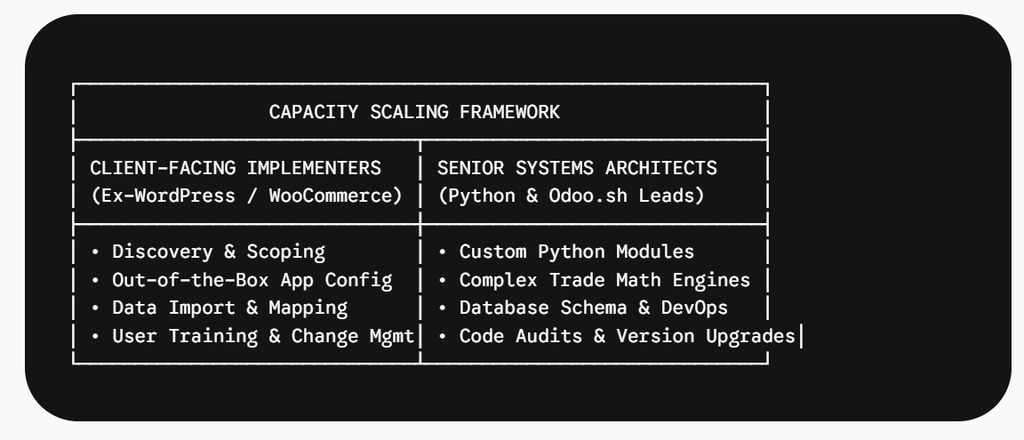
  • Adding people with capability in a rapidly growing market

    The explosive growth of WordPress from 2009 onward offers a clear blueprint for how the Odoo ecosystem will absorb and scale its needed labor capacity in Australia.

    Just as WordPress surged past a 10% market share by pulling in thousands of freelance web designers, PHP devs, and small agency owners who were looking to escape low-margin work, Odoo S.A. and Australian partners face the exact same talent pipeline dynamic today.

    Here is how the WordPress historical playbook predicts the expansion of Odoo’s skilled labor capacity, and how web implementers fit into that pipeline:

    1. The Migration of the “Web Freelancer” Class

    Around 2009–2012, building simple 5-page brochure sites on WordPress was lucrative. Today, dragging-and-dropping basic sites or setting up standard WooCommerce stores has hit a plateau. Freelancers and agency owners are feeling the margin squeeze.

    • The Historical Parallel: In the early 2010s, Static HTML/Flash developers migrated en masse to WordPress because that was where the client budgets moved.
    • The Odoo Shift: Experienced WordPress and WooCommerce implementers represent the most accessible pool of technical talent to retrain. They already understand:
      • Client discovery and requirements gathering.
      • Data structures (products, variants, SKUs, customer records).
      • Basic web APIs, webhooks, and front-end/backend touchpoints.
      • Managing non-technical business clients through software changes.

    Retraining a WooCommerce implementer on Odoo’s core functional workflows (Sales > Inventory > Invoicing) is significantly faster than teaching an enterprise SAP consultant how to be an agile, low-cost regional implementer.

    2. The Rise of “Hybrid Co-Delivery” (The Tiered Talent Model)

    In the WordPress ecosystem, non-developer implementers built massive businesses by pairing themselves with high-end plugin/theme PHP developers. The implementers handled 80% of the client-facing work, while senior devs built the custom backend logic.

    Odoo capacity will scale using the exact same division of labor:

    By removing the requirement that every consultant on an Odoo project must be a senior Python engineer, the market can absorb functional implementers to handle client onboarding, drastically multiplying total project bandwidth.

    3. Upskilling via Paid Ecosystem Training

    When WordPress exploded, platforms like WP101, Treehouse, and local Meetups commoditized WordPress education, turning graphic designers into functional web implementers almost overnight.

    Odoo S.A. and regional consortiums (like Scoop) will expand capacity by offering structured, paid “Cross-Skilling Pathways” specifically designed for web professionals:

    • Functional Certification Tracks: Teaching web implementers how Odoo’s double-entry inventory and general ledger behave compared to basic e-commerce checkouts.
    • Low-Code/No-Code Bridging: Showing implementers how to configure 80% of a client’s needs using native Odoo UI tools, Odoo Studio, and pre-built vertical modules before calling in a Python developer for the remaining 20%.

    4. Market-Driven Rate Elevation (The Economic Pull)

    Talent flows where the financial incentives are highest.

    In 2009, web developers realized they could charge $3,000 for a WordPress site instead of $500 for static HTML. Today, those same practitioners are discovering that an entry-level Odoo ERP implementation commands $15,000 to $50,000+ at billing rates of $150–$250/hr.

    This economic pull will naturally draw the sharpest local web implementers out of the stagnated CMS market and into the Odoo ecosystem – providing the exact labour volume Odoo Australia needs to meet national demand.

  • Unlocking the Next Open-Source Wave

    Why Web Developers Are Joining Scoop (Sunshine Coast Odoo Operational Partners)

    If you’ve been building websites for any length of time, you’ve likely felt a shift in the market. WordPress has powered our industry for nearly two decades, capturing over 40% of the web.

    But for many local freelancers and agencies, basic brochure sites and standard WooCommerce setups are becoming commoditized, driving project margins down while client demands continue to rise.

    The need for effective business operational software

    At the same time, your clients are likely facing a different operational nightmare. As local businesses grow—turning over anywhere from $2M to $20M—their software stack fragments.

    They try to connect WooCommerce to Xero, plug in third-party inventory tools, manage job scheduling on spreadsheets, and glue it all together with Zapier webhooks.

    They don’t need another marketing website. They need integrated software that makes their operations easier to run.

    That is why we are building Scoop (Sunshine Coast Odoo Operational Partners) – and why we’re inviting local web developers, agency owners, and technical freelancers to join us.

    What is Scoop?

    Scoop is a local group of web IT professionals working to capture the growing demand for open-source ERP (Enterprise Resource Planning) solutions across the Sunshine Coast.

    Just as WordPress revolutionized web publishing, Odoo is transforming business software.

    Built on an open-core model with Python and PostgreSQL, Odoo replaces fragmented app stacks with a single, unified database that natively handles CRM, Sales, Purchasing, Inventory, Manufacturing, Financial Accounting and lots more.

    Rather than attempting to tackle enterprise implementations alone, SCOOP brings local tech practitioners together into a collaborative network.

    The Power of the Co-Delivery Model

    Transitioning from website design to enterprise operational ERP consulting is daunting – particularly if you’re working in isolation. Being the sole-person liable for a client’s core general ledger or warehouse stock valuation is a big responsibility.

    Scoop helps reduce that barrier by establishing a division of labour based on complementary strengths:

    • Front-End & Client Co-Pilot: Leverage your existing client relationship skills, UI/UX eye, and discovery talents. Lead client workshops, manage day-to-day communications, configure core out-of-the-box modules (CRM, Sales, Invoicing), and run end-user training.
    • Odoo Technical Implementation: Provide Odoo implementation & systems architecture. Handle Odoo.sh cloud environments, data migration pipelines from legacy systems, complex trade/pricing math, high-level technical oversight, and custom Python module development.

    By pooling our skills, we present a formidable local delivery team capable of winning and executing high-value projects without any single partner taking on unmanageable technical risk.

    Why Join the Group?

    1. Move Up the Value Chain: Shift your billings from $3,000 brochure builds to $15,000–$50,000+ operational ERP implementations, unlocking consulting rates of $150 to $250/hr.
    2. Diversify Your Revenue: Build recurring annual maintenance and support revenue as your clients grow their operations on Odoo.
    3. Keep Your Autonomy: You retain your independent freelance identity and existing client base while tapping into Scoop’s collective capability when opportunities arise.
    4. Local Lead Distribution: As Odoo Australia routes inbound Sunshine Coast business inquiries to our regional network, projects are shared with members based on capacity, experience and domain fit.

    Ready to Build What’s Next?

    The transition from content management to operational ERP is the single largest land grab in open-source software today. You don’t need to be a Python wizard or a CPA (Certified Practicing Account) to start.

    You do need:

    • a solid foundation in web technology
    • the patience to learn business workflows from customers
    • a desire to deliver transformational value to local clients
    • the time & commitment to learn Odoo in detail

    Together let’s help build the operational engines that run Sunshine Coast businesses.

    Want to explore partnering with Scoop? Connect with us at our next local Meetup or reach out directly to grab a coffee and learn how you can help co-deliver your first Odoo project.

  • Introducing Scoop – Sunshine Coast Odoo Operational Partners

    Building a High-Capability Odoo Ecosystem on the Sunshine Coast

    Odoo Australia and their national partner network have built impressive momentum across Australia.

    To capture regional Queensland’s industrial and commercial growth, we’ve launched Scoop (Sunshine Coast Odoo Operational Partners) – a dedicated local delivery group designed to drive adoption, nurture tech talent, and support Odoo Enterprise ERP implementations across Southeast Queensland.

    Bridging Regional Demand with Local Delivery

    Rather than letting regional leads stall due to a lack of boots-on-the-ground support, Scoop provides a structured framework for local execution.

    We pair experienced senior systems architects with local technical consultants and client-facing project managers.

    This co-delivery model ensures that every Sunshine Coast business transitioning to Odoo receives high-touch onboarding, clear change management, and robust technical architecture on Odoo.sh.

    Community-First Growth: The Scoop Meetups

    Following the community model of the WordPress Sunshine Coast Meetup Group, we host regular Oddo Scoop Meetups on the Sunshine Coast.

    These sessions serve multiple purposes:

    • Introducing Odoo: Introducing local SMBs, tradies, distributors, and manufacturers to integrated ERP workflows.
    • Odoo Training: Training local web developers, agency owners, and technical freelancers in Odoo functional setup, data migration, and client discovery.
    • Odoo Ecosystem Expansion: [EXPAND]

    A Collaborative Resource with our National Partners

    For Odoo Australia, Scoop offers a reliable, certified local destination for inbound Sunshine Coast inquiries.

    When Odoo S.A. receives inbound inquiries from Southeast Queensland, Scoop provides certified, boots-on-the-ground delivery capability.

    We handle site visits, physical warehouse process mapping, shop-floor hardware setups, and local end-user training – ensuring high customer retention and zero project failure risk.

    Together, we’re helping expand Odoo’s footprint across regional Australia – one successful implementation at a time.

    Want to explore partnering with Scoop? Connect with us at the next local Meetup or reach out directly to grab a coffee.

  • Introducing SCOOP: Building a High-Capability Odoo Ecosystem on the Sunshine Coast

    To help capture some of regional Queensland’s industrial and commercial growth, we’ve launched Scoop – Sunshine Coast Odoo Operational Partners.

    It’s a dedicated local delivery network designed to drive adoption, nurture tech talent, and support Odoo Enterprise implementations across Southeast Queensland.

    Bridging Regional Demand with Local Delivery

    Rather than letting regional leads stall due to a lack of boots-on-the-ground support, Scoop provides a structured framework for local execution. We pair experienced Odoo systems architects with local Odoo technical consultants and client-facing project managers.

    This co-delivery model ensures that every Sunshine Coast business transitioning to Odoo Enterprise receives high-touch onboarding, clear change management, and robust technical architecture on Odoo.sh.

    Community-First Growth: The Scoop Meetups

    Following the proven community model of the WordPress Sunshine Coast Meetup, we host regular Oddo Scoop Meetups. These sessions serve a dual purpose:

    • Ecosystem Education: Introducing local SMBs, tradies, distributors, and manufacturers to integrated ERP workflows.
    • Talent Upskilling: Training local web developers, agency owners, and technical freelancers in Odoo functional setup, data migration, and client discovery.

    Consider having your next family holiday on the beautiful Sunshine Coast & time your visit to match up with one of our regular Oddo Scoop Meetups.

    A Collaborative Resource for Odoo National Partners

    For Odoo Australia, Scoop offers a reliable, certified local destination for inbound Sunshine Coast inquiries.

    For national Odoo partners, Scoop serves as a trusted regional co-delivery team for complex deployments, specialized manufacturing trade math, and site visits.

    Together, we’re expanding Odoo’s footprint across regional Australia – one successful implementation at a time.

    Want to explore partnering with Scoop? Connect with us at our next local Meetup or reach out directly to grab a coffee and learn how we can help deliver your next Odoo project.

  • Replace Xero with with an integrated Odoo ERP implementation using MetalFab

    Ditch the Xero Workarounds: Why Australian Fabricators Are Moving to Odoo with MetalFab

    For many Australian metal fabrication businesses, running operations on Xero, coupled with some home-grown spreadsheets has long been the default setup.

    While Xero handles basic accounting, it was never built to manage trade-specific steel fabrication, nested scrap tracking, or job shop scheduling.

    This disconnected architecture creates constant friction:

    • estimators manually key Excel figures into Xero,
    • stock counts drift, and
    • shop floor managers have limited zero real-time visibility into actual job costs versus estimates.

    Until now the only path forward has been an expensive custom ERP implementation like Epicor.

    The Integrated Alternative: Odoo ERP + MetalFab

    MetalFab provides a budget-disruptive path out of the Xero trap by converting Odoo Enterprise into a single operational system.

    Instead of relying on external plugins or manual data re-keying, fabricators get full end-to-end integration under one roof:

    • Native ATO Compliance: Odoo natively covers Australian tax requirements out of the box – including ATO Single Touch Payroll (STP Phase 2), GST tracking, automated BAS reporting, and Peppol e-Invoicing.
    • Integrated Trade CPQ: MetalFab replaces standalone quoting spreadsheets with parametric calculators for common fabrication niches like flashings, structural steel, and fasteners, generating accurate quotes and dynamic Bills of Materials (BOMs) quickly & easily in seconds.
    • Real-Time Job Costing: Because accounting shares the same database as inventory and the shop floor, labor tracked via touchscreen tablets and raw steel consumed on plasma cutters immediately post to your general ledger.

    By replacing Xero with an integrated Odoo implementation using MetalFab, Australian metal fabricators gain enterprise-grade ERP power at a fraction of traditional ERP costs.

  • Replace the many different SaaS apps you use with in an integrated Odoo custom implementation

    Stop the SaaS Sprawl: Streamline Your Metal Shop with Odoo and MetalFab

    Running a modern Australian metal fabrication shop often feels like … running a software company. You are likely paying monthly subscriptions for several disconnected SaaS apps.

    • dedicated accounting software for ATO compliance
    • SaaS application or spreadsheet tool for quoting
    • separate job-tracking app on the shop floor
    • another platform for inventory.

    This SaaS sprawl creates information silos, forces manual re-keying, and burns billable hours.

    Traditional ERPs are just too expensive for most Australian metal fabrication shops

    Fabricators are forced to choose between this fragmented stack or multi-million-dollar legacy ERPs like Epicor.

    MetalFab changes this by converting an Odoo ERP implementation into a single, fully integrated operating system tailored specifically for Australian fabricators.

    [Add Quote]

    Unifying Your Operational Stack

    By leveraging custom Python trade logic on Odoo.sh, MetalFab replaces your disparate apps with one continuous workflow:

    • Replacing Standalone Quoting Tools: MetalFab’s parametric engine handles complex trade math—like AS/NZS steel profile weights, flashing girths, and galvanizing surcharges—generating dynamic BOMs directly inside your ERP in under 60 seconds.
    • Replacing Disconnected Kiosk Apps: Odoo’s native touchscreen Shop Floor Application replaces third-party tracking apps. Machine operators scan jobs, record scrap, and view engineering drawings on industrial tablets in real time.
    • Replacing Standalone Accounting & Payroll: Out-of-the-box Australian compliance eliminates the need for external accounting syncs, bringing ATO Single Touch Payroll (STP Phase 2) and BAS reporting under the same roof.

    [Add Quote]

    MetalFab is built on the 80/20 Rule

    MetalFab provides 80% of standard Australian metal fabrication trade requirements out of the box.

    The remaining 20% is handled by configuring your shop’s unique competitive edge, such as custom machine rates or pricing matrices through MetalFab.

    By bringing quoting, stock, shop floor execution, and ATO accounting into a single Odoo ecosystem, fabricators reduce software incompatibility & costs to help run leaner, faster operations.

  • MetalFab for Odoo

    Introducing MetalFab for Odoo

    For Australian metal fabricators, calculating quotes, managing material yields, and tracking shop floor jobs often means wrestling with fragile spreadsheets or trying to bend their SAAS accounting system to actually meet their actual needs.

    Built on Odoo Enterprise’s open architecture, MetalFab acts as a tailored vertical solution that transforms Odoo into a dedicated operational framework for Australian metal fabricators including jobbing fabricators, sheet metal specialists, and local structural steel suppliers.

    Until now ERP has been just too costly

    Until now a fully fledged ERP implementation has been out of the reach of many metal fabrication businesses in Australia.

    Historically, comprehensive Enterprise Resource Planning (ERP) systems have been out of reach for local fabricators.

    Until now, fully fledged enterprise resource planning (ERP) platforms have felt out of reach for mid-market fabricators.

    • too costly
    • too much time & effort
    • too inflexible
    • too risky

    Traditional ERP solutions require massive upfront investments, months of risky implementation, and rigid configurations that break during minor operational shifts.

    Legacy systems like Epicor are often too costly, inflexible, and high-risk to implement successfully.

    MetalFab changes that paradigm.

    General Metal Fabrication Industry Software Solution

    Built on an the Odoo ERP open architecture, MetalFab is a tailored vertical solution that transforms Odoo into a dedicated operating system for Australian metal fabricators including jobbing fabricators, sheet metal specialists, and local structural steel suppliers.

    Legacy ERPMetalFab for Odoo
    High Upfront Capital CostCost-Effective Odoo.sh Hosting
    Months of Discovery80% Out-of-the-Box Baseline
    Rigid Custom CodeConfigurable Trade Modules

    Specialized Niche Architecture

    The system uses a core metal fabrication engine paired with targeted vertical modules to solve specific trade math. [EXPAND]

    The system uses a core calculation engine paired with targeted vertical modules to solve complex trade math:

    • Structural Steel: Integrates AS/NZS section catalogs, automated member mass calculations, and surface treatment rates.
    • Sheet Metal & Flashings: Calculates coil slitting yields, flat-sheet girth development, and press brake folder hit counts.
    • Local Metal Supplier:

    Built for the Shop Floor

    Deployed via Odoo.sh, MetalFab combines custom metal fabrication trade logic with fully managed, cloud-hosted security.

    Deployed via Odoo.sh, MetalFab pairs trade logic with fully managed, cloud-hosted security.

    Machine operators replace paper job travelers with touchscreen shop-floor tablets to track actual labor, record scrap rates, and view engineering drawings on the fly, giving real-time visibility into actual versus estimated job costs.

    MetalFab slashes traditional ERP implementation costs, empowering Australian metal fabricators to work smarter and scale efficiently.